Wednesday, 25 July 2018

Making Sense of Children's Thinking and Behaviour

Making Sense of Children's Thinking and Behaviour

A Sep-by-Step Tool for Understanding Children with NLD, Asperger's, HFA, OD-NOS, and other Neurological Differences

by Leslie Holzhauser-Peters & Leslie True

ABSTRACT LANGUAGE

 As an adult when you talk to them it seems like they understand ... because the conversation seems so normal and the child has no visible disability, it's almost impossible to believe that they have difficulty responding to simple commands or language that much younger children understand. Many of our daily interactions and instructions involve abstract language, such as; 'sit still', 'pay attention', and 'listen'. These are common and the expectation is generally understood so it makes it hard to believe that some children do not understand this. Some children do not innately recognise that to pay attention they need to look at the person speaking, they just assume that if they are 'listening' to the speaker that they are correctly following an instruction, even if they are drawing at the same time. When the teacher says put your hand up, the child may do so whilst blurting out the answer, completely unaware that they are not adhering to the general expectation.
Another example of literacy interpretation involves compound words as well as homonyms and homophones. 
Children diagnosed with neurological disorders often use advance vocabulary even when they don't understand the meaning.  They have just heard the words used in a certain situation. 
They often don't understand the intent behind words eg. 'What did you miss when you were with your counselor today?'. They might answer 'nothing' as they didn't miss anything as they were where they were supposed to be. 
It is best to ask if they understand not to just assume that they do. Abstract language understood literally leads to confusion.


Things to consider:

  • Think about the question you asked if you get an unusual response
  • Don’t assume they understand, check if they do
  • Think about double meanings
  • Consider abstract terms
  • Rephrase questions, directions and commands
  • Explain, explain, explain all abstract language you hear or read
  • Put yourself in their place and try to think in the way they do

MOTOR

 These children often have motor deficits both fine and large. Although fine motor skills might be a problem in some areas they do not necessarily go across the board.


Things to consider:

  • Analysis the environment for possible safety concerns
  • Survey the environment with the child pointing out potentially dangerous areas
  • When selecting activities involving motor skills, decide what the benefit from engaging in this activity will have for the child (social, emotional & physical)
  • Let them participate in activities to the extent that they are able, exposing them to different activities, and discussing their interest
  • Don’t rule out sports altogether if team sports don’t work. Consider individual sports such as golf, archery, horseback riding etc as well as other social outlets such as chess club band etc.

SENSORY

 Something as simple as closing a door can be misconstrued, because what they actually do is slam it, so if you font understand that they can't feel how hard they are closing it, you may perceive them to be angry, upset, destructive or defiant.It is necessary to believe that each child has reasons to ach in the manner that they do. It's the job of those who care to determine the why of their behaviour and consider sensory as one of the possibilities.


Things to consider:

  • It’s important to pick your battles
  • If it doesn’t impact someone else negatively, let it go
  • Think about how an environmental change will help the child to cope
  • Put yourself in the environment and think about how you would react fi you were sensory hypo or hyper
  • Explain to the chld how they’re sensing the world differently than others


SPATIAL ORIENTATION


 The spatial orientation and motor areas often combine to  make children with neurological differences appear uncoordinated and clumsy, As they walk through their environment they have a tendency to walk unawares into door frames and bump into other people. They can have trouble finding their way back to their seat as they simply forget where they have been sitting.  Spatial orientation issues make it difficult for children with neurological differences to find their bodies in space.
As writing is the most common method teachers use to assess a strudent's knowledge it is an area of concern for students with spatial difficulties. Writing and colouring in the margins, lining up numbers on math worksheets, interpreting graphs and maps, and visually busy worksheets are all areas that present problems. 


Things to consider:

  • Familiarise children with the environments they will encounter and provide as much support as needed for them to remain safe
  • Practice routines they will need to take in various environments
  • Mark routes with stickers on wall, tape on the floor, point out or list landmarks
  • Keep arrangement of the environment the same
  • Provide an organisational system at home and school - for example; label shelves, colour-code binders
  • Allow additional time for moving from one location to another if necessary
  • When analysising behaviour, consider whether it can be attributed to the child’s lack of ability to find their body in space
  • When accidents occur, consider their visual spatial ability to maneuver iterms

CONTROL/CONSISTENCY

As there is so little they can control they search to find what they can.If the class is scheduled to finish at 11:30 they might feel it there duty to notify the teacher by yelling it out across the room.


Things to consider:

  • Provide a schedule and have a routine.
  • Explain changes ahead of time
  • Pick your battles
  • Consider wether you want a behaviour to become routine.
  • Give in-depth explanations.
  • Tell the child what to do instead.
  • Considere how much support is needed to help them enter new situations.


THEORY OF MIND (Thinking about others thinking)

The ability to think about someone else's thinking affects the way you react in a social situation. Someones aptitude at using developed social skills is dependent on the degree to which they have theory of mind. As you go through your day, you make judgements about the intent of others. If you think that someone else has made an honest mistake or accidentally done something, you will react differently than if you feel they have done it on purpose.

They may not be able to see the benefit of someone else winning at something.  

Those of us with developed theory of mind capabilities understand others have mental states different to our own. Our discussions and conversations with others include the language that denotes these mental states, such as 'in my opinion', 'I believe' and 'I think'. when you are mindblind, however, you don't have those mental state verbs at your disposal as you do not realise that there is a mental state other than your own. No-one should, would or even could think of anything other than their idea.


Things to consider:

  • Only asking ‘How would you feel if it was you? is not enough
  • Explain, explain, explaining in different ways and in different situations
  • Involve  the child in selecting cards and gifts for a person and discussing why it might be appropriate for that person
  • Discuss what other people might be thinking, as you read a book together, watch a movie and observe people when you are out in public
  • Look at commercials , ads and talk about what they are trying to get you to think about
  • Give the child small jobs that require them to think about the needs of others; feed a pet, walk the dog, water plants ...

SOCIAL COMMUNICATION

Children diagnosed with neurological differences are often unable to relate an event as it happened because they don't have the communication skills of explanation. The information they provide might be too much or too little and they also lack the ability to monitor the understanding of their communication partner. With holding break times is not a good 'consequence' for these students as they need the practice. No teacher would ever say you can't participate in reading or writing today because you were disrespectful ... reading and writing are too important. 

Inability to read, understand and react to social cues, coupled with their naivety resulting from their mindblindness, makes these children potential victims for bullies, as well as predators.


Things to consider:

  • Tell children when they are doing something correctly and why it is corrct
  • Teach them social skills
  • Focus on imiproving one or two skills first, start with those that make the child stand out
  • In place of an inappropraite social skill teach them what they should do
  • Rehearse social situations
  • Wathc people, movies, videos and talk about what the characters are doing and why
  • When they seem rude and uncaring ask if they intended to hurt the person’s feelings
  • Place children in situations where they can feel success
  • Communicating via the computer can ofern facilitate success because the child only needs to read the message in print and not read into social cues


EMOTIONS

The way others perceive the emotions of these children is often far from the way it really is. basing reactions solely on what you see is definitely a mistake, what you see is very rarely what you get. They are unable to idenitify their emotions and as a result are unable to manage their feelings.


Things to consider:

  • Don’t assume that you now how the child feels based soley on their outward appearance
  • As situations present themselves throughout the day talk aloud about how you feel and why
  • When you have a good idea about what the child might be feeling, identify their feelings for them and realte it to the physical feeling they may be having
  • Point out both the obvious and the subtle social cues that convey certain emotions
  • Explain their atypical responses to those who are willing to listen
  • Teach them to use the 1-10 sclae to identify the intensity of their feelings
  • While reading or watching a video, discuss the characters’ feelings and why they might feel that way and the clues that make you think so.

MENTAL FLEXIBILTY

Children with neurological differences can look happy when they are not, look like they understand when they don't and to further complicate the matter they can't always take a learned skill in one situation and able it in another. 


Inability to generalise is another result of inflexible thinking. What the child learns in one situation can not be transferred to even a similar circumstances much less one that bears no resemblance. Often this inability reinforces the thinking that their behaviour is intentional and intended in a negative way. 

Their inability to use cause and effect thinking leads them to act our a situation in order to determine the outcome.

The flexible thinking as well as the inability to generalise associated wuth their disorder results in their inability to learn from past mistakes which is why consequences are ineffective. There is no question you can punish endlessly, but in the end, what is required is a logical explanation accompanied by a description of what to do instead.


Things to consider:

  • Use the child’s strength to teach - detail-oriented, factual, logical
  • If the question a child asks seems meaningless, probe further to see what the child is thinking
  • Explain, explain, explain the why of everything
  • Don’t expect the child to know how to apply acqired knowledge or skill to a new situation
  • As you watch television or videos, discuss the big ideas the writer is trying to communicate
  • Try to make abstract concepts as concrete as possibly by describing how the look and sound - when someone tells you to listen, that means to look at the person, sit quietly, don’t move etc
  • Help the child select the important information when they are required to summarise, explain … Provide them with graphic organisers and strategies
  • Help the child to work in groups to facilitate interactions and understand their role, so they don’t appear bossy and perfectionistic


IMPULSIVITY


As they are literally being asked to do something they are incapable of, children, with impulsivity issues begin to stick out when compared with their peers.


Blurting out answers is a common behaviour with children lacking impulse control, although they are unlikely to have had time to think through an answer so their response is often lacking. If you pursue their thinking with guiding questions, it becomes apparent that they know so much more that their original answer indicated. 

Another recurring problem at school for children with control problems is their need to rush through classroom assignments.


Things to consider:

  • Keep in mind that the child can’t help it.
  • Being patient will lessen the effect.
  • At anxiety-provoking times, try to decrease demands and expectations.

  • For persistent, recurrent impulse-related problems, such as blurting out answers, consider strategies to deter impulsive reactions, such as a reminder card.
  • Consider phrasing sentences carefully - instead of ‘ Who knows the answer to …’ say ‘If you know the answer, raise your hand’.


EXECUTIVE FUNCTIONS

Executive functions are the skills that allow one to plan, sequence, organise, prioritise and problem-solve in order to complete tasks. They are unable to find a solution to a problem and often not identify that one exists. Children with executive function deficits need someone to provide that consistency in order to give them the best chance to succeed. The executive function involved in completing homework, planning, organising, sequencing, prioritising, and actually finishing work, make the tasks surrounding the actual homework impossible to complete independently for someone with a deficit in this area. Deficits in the areas of organisation, planning, sequencing and prioritising all combine to make problem to make problem-solving difficult. Executive function skills allow us to operate in an organised manner, giving life order.


Things to consider:

  • Make necessary accommodations. Determine if the child’s ability to show what they know is being compromised.
  • Constantly monitor tasks providing scaffolded support. You model the task, do it together, and then they try it by themsleves
  • Help them to priortise tasks and long-term projects, providing a reasonable time for completion
  • Chunk information into smaller bits.
  • Provide strategy and supports in the way of graphic orgnanisers, lists etc
  • Think aloud as you problem solve situations so the child can her the process of your thinking
  • Visually display the steps of problem solving in an easily accessible place, so that as problems arise you can use them to look at options or alternatives
  • Remember that the inability to problem-solve can be impacted or have impact on other deficit areas.


ANXIETY


So often the worries of children with neurological differences are dismissed as insignificant, which only serves to compound the problem.The bottom line is that if you don;t address their anxiety, the problem you judged to be insignificant will be yours shortly. They live in a world that is confusing and frightening because they can never be sure how to respond to the world around them. When you face a world each day where each action has the potential for disaster, how could you not feel anxiety? These children have great difficulty identifying their emotions, as well as expressing their worries. 

When you are unaware of a problems, your odds of fixing it are greatly increased. These students often use phrases like, 'Am I in trouble?', 'Am I ok?' and 'Are you mad at me?' These aphrases are requests made to adults to obtain an expression of reassurance. If you are unsure of when you've made a mistake, it makes sense to regularly check to see if you have,

Knowing that someone doesn't like them makes them anxious, causing them to try to fix the damage even though they're not sure what the damage is.

Sometimes test situations might be less stressful than a typical school day.

Unless anxiety is addressed and at least minimized, the child will be unable to deal cognitively with any other areas. What may seem insignificant to you is real to them. Minimising is a high mistake.


Things to consider:

  • Do whatever it takes to make the child feel safe and protected in their environment
  • Provide a safe person at school
  • Ask them frequently if they feel safe
  • Teach them what to do in different situations
  • Help the identify their anxiety ad the physological changes that occur as a result
  • Provide them with techniques to control their anxiety, such as relaxation exercises and cognative behaviour therapy
  • Let them know everyone feels anxious at times
  • Talk out about their anxiety - tell them how you feel and why
  • Don’s dismiss their anxiety. It doesn’t matter if the anxiety seems real to you or not. If it’s real to them you need to address it


BELIEVE
The most frustrating aspect of having a child with neurological differences surprisingly, is having to try to convince others to believe the enormity of the deficit areas faced by these chilldren. The most important step you can take in improving the life of these children is believing. With believing comes a willingness to think about the world through their eyes. Parents of children with neurological differences spend enormous amounts of time and energy thinking about their child and their needs.They know what works for their child and what doesn't.

ALL BEHAVIOUR IS MEANINGFUL

Once you begin to ask 'why?' things get better for everyone because you are not just reacting to a behaviour.  It's important to remember you have a better chance of achieving your desired goal by asking why and getting to the root of the problem, as opposed to punishing the result of their behaviour. 

Parents of children with neurological differences spend enormous amounts of time and energy thinking about their child and their needs. They know what works and doesn't work for their child. Believe the parent.


Guidelines:

  • Believe the parent
  • Reduce anxiety
  • Be kind
  • Check often for deep understanding
  • Explain everything
  • Don’t automatically assume that negative behaviour is intentional; try to determine the cause
  • Tell them what to do instead
  • Don’t engage them in a power struggle
  • Try to see the world through their eyes
  • Enjoy them and laugh with them


Cultural Responsive Practice

Nathan Riki - presenter
Hapū - before pakeha people came to Aoteroa Māori people were not called Māori. Māori (normal) can refer to anyone who comes from a place. Originally Māōri were known among themselves as Hapū.

It is our responsibility to ensure that the obligation to the.

Treaty of Waitangi Principles: 


partnership - engaging with the community, inquiry-based finding out the Māori origins of the area  (rōhe), Māori representatives on the Board, power-sharing

protection - valuing, validating and protecting local knowledge, all tamariki must  have some Te Reo Māori instruction, learning and including tikanga school-wide, achieve success as Māori and create spaces for our tamariki that encourage rangatiratanga, mana, places that suit their learning styles and harnessing individual skills. 

participation - working to strengthen home/school relationships, Māori participating in school decision making, school reflection of biculturalism, aspirations of Māori whānau reflected in school planning and do our whānau feel safe in our school.

Anne Milne - your opinion of yourself is formed by other opinion of you

Warrior Scholars - video


Wednesday, 25 April 2018

Community of Schools’ (CoSs) leadership

Community of Schools’ (CoSs) leadership 

Throwing money and hoping for success? By Linda Bendikson


Improve learning outcomes by having successful teachers and Principals share their knowledge across schools. 

Leaders need to engender trust and confidence.

On the job competence - identify problems and find solutions
Start with smaller problems to build up accomplishment. the people who did the work need to take on the goal as their personal goal.

School -
What is impeding learning?
Need data literacy to discover the answer.

Why does the process fail in schools sometimes?

  • Leader is not tunnel-visioned (trying to take on to many goals)
  • Leaders do not measure immediate outcomes and provide feedback
  • Leaders do not sustain their involvement (they slowly drift away)
Skill of a good Cross COL Leader
confidence in ones own knowledge of the process
courage to take a strong lead
ability to inspire others to act in a timely way


HOLDING OTHERS ACCOUNTABLE
We are all in this together!!


Leading in collaborative, complex education systems 

Commissioned paper for New Zealand Education Council - Matatū Aotearoa Jane Gilbert AUT University August 2015

System wide change has to come from within the system. not from the top down. For the modern world a new approach is needed, not just a change in vocabulary. 

Complex Thinking
Previously educational thinking was 'scientific thinking'. Each part was the part of a machine and interconnected and linear. There was stability, predictability and certainty. Systems were a closed circuit.
On the other hand complex thinking is about the system. These systems adapt quickly to changing conditions (like a flock of birds flying).  Small changes to the system can have big effects and big changes can have little effects. 

Leading in Complexity
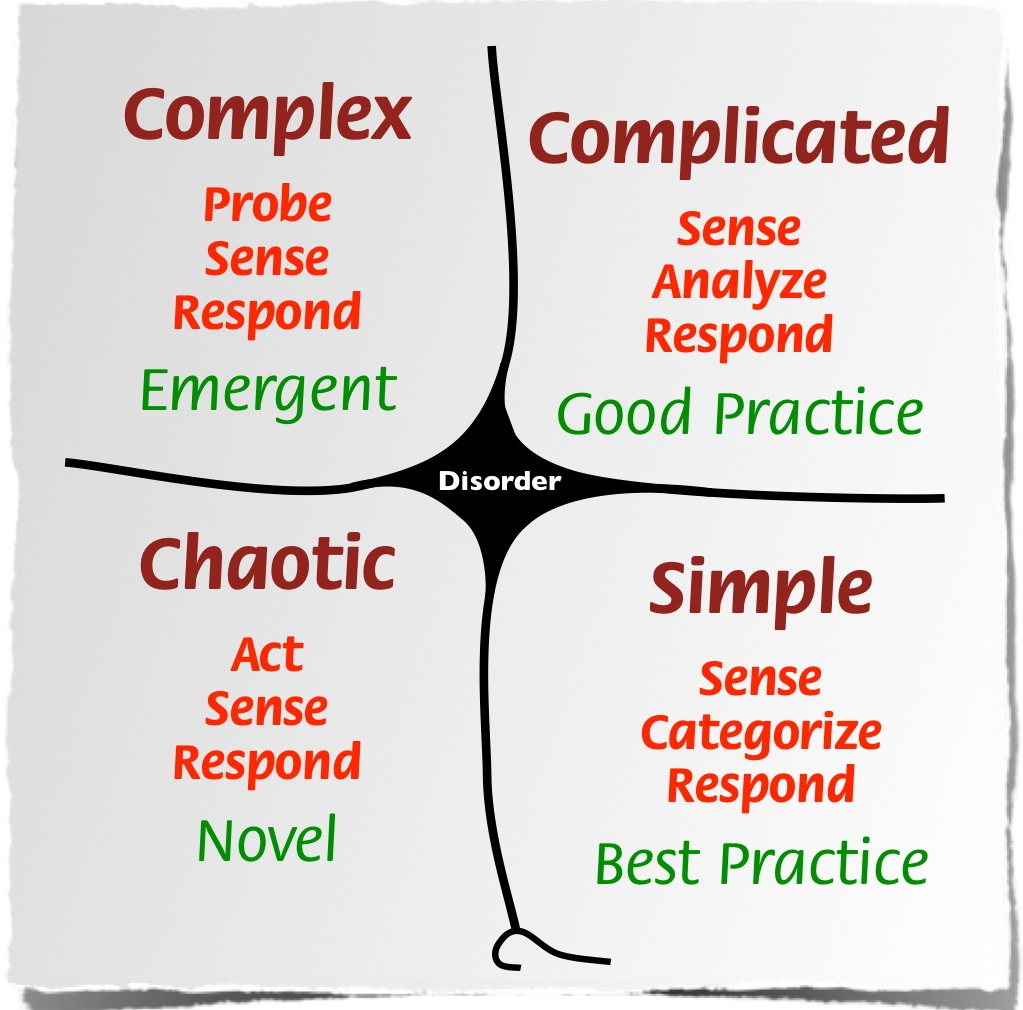
(Snowden & Boone 2007)  Before making a plan in any given situation  you need to decide whether the situation is simple, complicated, complex or chaotic;

  • simple - follows a pattern/sequence; occurs regularly and can be responded to by formulas.
  • complicated - also reliable and predictive, but no one knows why - data must be collected and analysed. Once experts are agree a  formula can be developed and followed
  • complex - the realm of the unknown. Nothing is predictable or reliable. Complex systems cant be controlled but can be steered towards a vision. The most useful thing is the noticing of the emergence of new patterns. 'One-size fits all solutions most likely won't work


Image result for Snowden’s Cynefin Framework 1
Snowden’s Cynefin Framework


Leading in a Complex Education System:
Important things; collaboration, secure trusting reationships
BUT the most important is a commitment to moving forward together
leaders should not have any ideas as to an ideal solution, all ideas are to be put forward

Think-piece on leadership education in New Zealand 

By Dr. Jan Robertson


Effective Educational Leaders;
  • self-aware
  • think deep about their practice
  • system leaders (care about students at the school down the road as much as those at their own school
  • are partners in realationships
  • emotionally, socially culturally and cognitively intelligent and responsive - see importance in developing those around them
  • creative, informed thinkers
  • confident and intentional
  • digitally competent
  • comfortable with being outside their comfort zone

Coaching leadership and potential in others is a facilitative  practice which is based on collaboration, the sharing of ideas, focused on the creation of knowledge. Leaders need to know how to learn from their own practice with and from others


Networked Leadership

 By Derek Wenmoth

School leadership is recognised as a priority area in many countries. Since 2011 NZ has had the National Aspiring Principals Programme. Australia have chosen a more systematic approach with the opening of the Australian Institute for Teaching and School Leadership.

  • Challenges in NZ schools:
  • competition between schools
  • hierarchical approach to school leadership
  • lack of accountability in current leadership  development programmes
  • lack of leadership development pathways
  • lack of rigor around entry to leadership programmes


A educational community is an ecology rather than a structure that can be owned or managed. 
The onus must be on the leader. No amount of coercion will make a community operate, no matter the structural planning and thinking.

Key Principals that will increase the likelihood of success;

a set of well researched professional standards for leaders
theory and practice are linked to professional standards
design programmes of support and engagment
build support around coaches and mentors
allow the community to grown through through fluidity 
provide tools to measure the programmes effectiveness
provide a range of blended learning programmes
robust, modern learning environment within which interactions and discourse can happen


Leaders need to;


  1. change thinking
  2. change behaviour
  3. change system

EDUCATIONAL LEADERSHIP FOR TOMORROW 

Mason Durie 


Leadership should be - inclusive, strategic and collabrative

INCLUSIVE - leaders are aware of the inter-relationship they have with others, others success leads to their success

STRATEGIC - a knowledge of what needs to change and the ability to manage change

COLLABORATION - knowledge of the power of collaboration

Leaders for Learners - are enthused with the vision of learning for a community and everyone is involved, their first priority is learners of the community (not of a particular school), recognise the value of whanau, form alliances between schools, aware of community needs so appropriate opportunities are offered.

 "Strategic leaders want learners to be ready for change and to acquire new ways of gaining and processing knowledge".


Wednesday, 7 March 2018

Making Space For Learning

Making Space For Learning

Trauma Informed Practice in Schools

  by the Australian Childhood Foundation


Understanding Trauma in Children

Traumatised children frequently do not have their feeling acknowledged. They do not trust their feelings. The strength of their fear, shame and sadness can overwhelm them. They often experience problems with learning new things, coping with new people and situations. the memories of the abuse are pronounced and ever present. Small reminders may cause them to relive their fear and confusion. 

What is Trauma?

Simple trauma - Overwhelming and painful, life-threatening and or/have potential to cause serious injury. Often a single incident, shorter in duration. Egs, earthquakes, car accidents, house fires, bushfires and cyclones
Complex trauma - involves inter-personal threat, violence and violation. Includes multiple incidences and therefore a longer duration. Almost always associated with stigma and a sense of shame by the victim. Egs, child abuse, bullying, domestic violence, rape, war and imprisonment.
Developmental Trauma - Trauma that has effected the child's brain development, often leading to splintered development.  The trauma undermines the very resources that could help the child recover - the stability and predictability of their connections with others.

How Complex Trauma Effects the Developing Brain?

Complex developmental trauma reduces the capacity of the thinking part of children's brains to shape the way they react to challenges in their environment. As a result they appear to behave instinctively and sometimes inappropriately, without knowing why. They are also not able to easily influence their feelings when faced with perceived threat or increases in their experience of stress.
It impairs the bridge between the left and right hemisphere. As a result, the children find it difficult to name their feelings, read social cues and respond in social exchanges. 
It heightens their arousal base to the extent that they can live in a constant state of vigilance and heightened alarm. They can be easily triggered by seemingly minor issues.
It locks down their capacity to adapt to change in their environment. They will use fixed and repetitive behavioural routines in situations where they feel uneasy, as this is comforting - even if the routines are destructive or harmful to others.
They will lack the ability to adapt to changes in situations and contexts.
They will react rather than respond.
They are unable to take in much information as their brains are in overdrive.
Their memory systems are under stress so they will fail to consolidate new information.
Their future is without plans or a sense of possibilty.

Trauma And The Body

For traumatised children the best option is to always be alert to danger and consider any change a threat
The body makes itself as efficient as possible by inhibiting any non-survival-related process such as digestion.
It focuses on conserving energy and resources for survival. There is no room for new information to be considered.
The brain and body respond in thinking, feeling and behavioural patterns which are ingrained.
Exposure to chronic stress desensitises the threat detection area of the brain and sometimes a threat can be perceived when there is none.
The individual becomes stuck in this cycle of trying to keep everything as familiar as possible. They rely on parents and caring adults to help support them by removing the threat or reducing its impact.
Children may not progress much further than the milestones they had reached when the trauma began.
The best way to support these children is to adapt the environment to the child's needs. The environment needs to be safe, predictable and nuturing.
Those working with these children need to be understanding and compassionate and offer orientation for hope and growth.

Trauma and Memory

When routines change the children are disrupted. Interaction with carers that repair disrupted routines engender trust in relationships.
However, children who are provided with chronically inconsistent responses are unable to form the memory templates they subsequently need to feel settled.
As children mature they are able to store language and concepts. Memory structures increasingly develop the capacity to store sensory dimensions separately to to the details (the who, when, where) Recall can bring about memories without sensations. Sensations can be described separately and with the events which precipitated them. They are able to reflect on memories in clam states. They can suspend painful memories in time so as to not be overwhelmed by the intensity of sensory experiences from their past when it is counterproductive to them.
However, memories are different for a child who has been through trauma. When they are exposed or confronted by cues associated with the trauma their memories flood back with the full force of sensory memory fragments. The child is, in the moment, unable to understand that the response they are having relates to the threat of harm posed by the raised voice of an abusive parent in the past, and not by the non-threatening raised voice in the classroom at present.
As a result they shut down their memories and do not engage with them, As such they do not rehearse building memories about themselves overtime andn will struggle to recall their success stories about themselves and relationships. Their memories do not form the stories they need to understand who they are, what they are good at and what relationships with others means to them,
Traumatised children need relationships that provide the memory resources that they lack or actively do not use. They need opportunities to keep their memory systems active through practice and rehearsal in conditions in which some of their internal stress and arousal has been reduced. In calmer states, children have access to greater cortical resources. They begin to have greater access to their working memory. They are able to consolidate learning. Traumatised children need to relief of a safe place to lay down new and helpful memories, which in time can begin to supersede the pain of their past.


Trauma and Emotions

Children who have experiences trauma have limited emotional literacy. They do not understand their feelings and are unable to explain them for others to understand. Negative and critical feelings, suh as confusion, shame, guilt, disgust and worry can trigger off memory traces of the trauma. 
Traumatised children cannot easily access their cortex to calm themselves down or regulate the strength of their feelings. Adults in their lives need to calm and comfort them to sooth the cortex. Children become aware of their internal state by seeing how others react to their feelings, this is how they develop emotional literacy. Children compose a framework for their feelings from the predictability of the responses they receive from others to their behaviour and emotional state. Predictability is the key through which children manage to negotiate how they have their needs met in their social exchanges. Consistent, congruent and validating responses give them the effective blueprint for organising their internal world.
Instead of validating and acknowledging a child's feeling and abusive parent or carer may escalate the child's confusion or fear by responding aggressively or blaming the child for their behaviour. In unpredictable relationships, parents and carers may sometimes respond safely and supportively, then without warning, they might react angrily, aggressively or negatively. In this situation, there is no predictability, so the child's life remains disorganised. The child does not trust the external world to offer stability.
Another emotion experienced by traumatised children is the feeling of disconnect, It serves the purpose of allowing them to disconnect so they do not feel so strongly the abuse.
When they are triggered, their emotional states are re-experienced with the similar intensity with which they were stored.Tracking a child's emotional states over time is a way of staying i touch with how, why and when different feeling become experienced and expressed.
Emotions assist children to belong to a social group who share their feelings. Traumatised children often feel different to others. If trauma or stress occurs during periods of time when the right hemisphere is more dominant in its maturation, then children will experience difficulties in being
able to read and interpret social cues of others. They look for others whose history and background makes its easier for them to be with. In this group they do not have to tolerate others feelings because there is only a limited range of feelings ever expressed. Without intervention aimed at supporting better connection and social skills, traumatised children are likely to experience increasing levels of isolation.
Traumatised emotional states affect children without warning and invisibly.

Trauma and Relationships

The more predictable the response to them the greater the confidence that children develop in both what they feel and how they understand the world. In particular, they learn that they are able to solve problems.
Supporting children to re-experience relationships differently is the key to trauma recovery and change. These compensatory relational experiences centre around the following key features:

  • there is a consistent approach to communication
  • children have their feelings validated and acknowledged by adults
  • children experience adults being protective of them 
  • children experience adults trying to take care of them even when their behaviour is challenging and complex.
With these examples the children can have hope that not all adults are the same. Over time, as the experiences are repeated, they become working templates for the children to apply in social exchanges and relationships.

Trauma and Behaviour

Comfort seeking - Children will seek out comfort from people whom they see as safe, consistent and nurturing. This includes seeking out physical attention from others, sitting close and engaging in parallel play, wanting to be fed and wanting their hands or heads to be stroked. They might engage in self soothing routines.
Self protection - Children will try to avoid intimacy at all costs. They do this for their own protection.

The key to reshaping trauma-based behaviour is to understand it and respond to its source rather than how it is expressed. Small examples of teasing can be experienced as large shifts in allegiance, rejection or humiliation. The relationship component of behaviour needs to be kept in constant focus when trying to understand the needs of children effected by trauma.
Trauma-based behaviour has served a survival function for the child. It may continue to serve its purpose in the child's current context. As such, this behaviour is most likely to stop when its function is no longer needed. These children will not necessarily respond to incentive-based reward systems. 
Strategies for addressing trauma-based behaviour will be most successful when they are applied purposefully across multiple settings in which children live, play and learn. With reduced memory capacity traumatised children and young people will find it difficult to generalise their learning from specific situations to related and unrelated contexts. No single approach will work al the time. Always consider the internal stress levels experienced by the child. Effective strategies will offer comfort and calm as the basis for change, aleviating additional stress on an already stressed body-brain system.

Trauma and Learning

The ability of traumatised children to learn is greatly compromised. Their neurobiology is stressed, their realtionships feel unstable, their emotional state is in flux, they find it difficult to stay calm or regain a state of calm if they feel distressed or perturbed. Change is perceived as dangerous, their memory is under pressure, they are disconnected form themselves and time, their behaviours rule them and new experiences and new information carry with them elements of threats and uncertainty.
Depending on when the trauma happened during brain development children may experience difficulties with being able to process language, difficulties with executing logic and sequences tasks (this will mean maths and problem solving tasks will be extremely difficult), they will find narrative-based techniques complex and at times indecipherable. As sport they will struggle to play.
Also the constant interaction with others will cause a lot of stress.

Using SPACE


Staged
Predictable
Adaptive
Connected
Enabled


Trauma informed practice has as its main ambition to support children to reset their baseline internal stress and arousal levels in order to bring their cortext back in line.

Staged - Strategies aimed at resourcing traumatised children need to follow a staged pattern of conceptualisation and implementation for them to succeed.

Predicatabilty - The people and the environment in their lives needs to be predictable. With stress reduced the children will have the chance to experience themselves as more flexible and be more able to tolerate small degrees of change.

Adaptive - In school contexts, traumatised children struggle to internalise collective rules and understand the consequences for breaking them. Strategies which promote adaptability in children are those which are able to maintain multiple meaning for behaviour and remain open to multiple options for intervention.

Connected - Traumatised children develop insecure and unstable templates for forming and maintaining relationships. Effective strategies to support traumatised children emphasis relationships with safe and consistent adults and peers as the foundation for change. Relationships become the primary vehicle through which new meanings about feelings, beliefs, behaviour and idenity are resourced to emerge.

Enabled - Traumatised children find the process of understanding themselves difficult. They are challenged in their capacity to identify their feelings and understand them and communicate them to others. Effective strategies for responding to traumatised children in the school context will enable them to make linkages between and give meaning to their experiences of their past and their present, the feelings and their behaviour, their thoughts and their actions.

Putting Space Into Practice

Suggestions - 

  • create spaces for the students to move into and still be part of the class group. Tactile corners in the classroom that have beanbags or a rocking chair, stress balls or a plush rug.
  • create structures in which children can make choices during their day.
  • written plans for children that are made accessible to relevant school staff.
  • keep a journal of the child's emotions over the course of a week. Look back to see what factors are influencing a child's behaviour
  • capture and record the experiences of a student at school every week. Join the child in reflecting on these experiences in a sequenced way that enables the student to rehearse building a narrative about their involvement at school. Recognise and acknowledge the student's involvement in school activities.
  • provide impromptu fun experiences which are not defined as rewards. Fun and playfulness act as resources in the lives of stressed children.
  • use a digital camera in class to 'catch' the students doing the right thing and help them reflect on their strengths and commitments.
  • Include stretching and physically relaxing activities at predictable times each day
  • create a calm box; photos of favourite things, sensory rich objects
  • build rhythmical rehearsal opportunities that support arousal regulation.  For example, use the excitement - calming - concentration phases in regular classroom activities throughout the day
  • set up a shadow board outlining what the students will need to each class/lesson/subject
  • integrate emotional literacy activities into the curriculum to support students to recognise, name, manage feelings and learn to respond to others' expression of feelings
  • rehearse narrative structure by drawing the day's journey using different media including chalk, text, wool, clay
  • create videos/dvds which provide a history of the year/class/week/camp experience and enable review of this work
  • utilise music in the classroom -  particularly rhythmical drumming

Final Words:

Hope is the outcome of change for children. For these children, hope comes from feeling that their experiences of trauma and stress no longer separates them from their friends and family/ They know that they do not have to feel alone any more. They can feel safe, secure and loved. School itself becomes easier to navigate. They have greater attentive capacity. They have access to more of their memory resources. They can take in more information and store it. They can recall it and integrate it. They develop new skills. They learn and come to enjoy learning.