Sunday, 6 August 2017

Oracy In the Classroom   30/07/2017

Text

Create discussion guidelines:

  • Always respect each other's ideas.
  • Be prepared to change your mind.
  • Come to a shared agreement.
  • Clarify, challenge, summarize, and build on each other's ideas.
  • Invite someone to contribute by asking a question.
  • Show proof of listening.  (important as this shows respect)
We need to teach children the different roles in a conversation:
  • instigator - starts the conversation
  • builder - builds on and develops further other people's ideas
  • challenger - provides an argument
  • clarifier - makes things clear (like a commentator)
  • prober - asks questions to go deeper
  • summarises
Activities that encourage speech

  • talking points: students need to say 'I agree or I disagree because ...
  • ghost reading: students takes turns to read but decide how long they read for
  • collective writing: after writing on a topic students collectively talk about it, each choosing how much they say
English
  • A similarity between these texts is…
  • A difference between these texts is…
  • The author's choice of X shows…
History
  • In this era…
  • This artifact shows that…
  • This source illustrates that…
  • This source is biased because…
  • This source is more reliable because…
Art
  • I like this picture because…
  • I prefer the work of X because…
  • The composition of this piece shows that…
  • The techniques I have noticed are…
Science
  • The results show that…
  • The conclusion I have drawn is…
  • There is a correlation between ... and ....
  • An anomaly I noticed is…
  • I have observed...


Notes from Behavioural Course

Individuals are more likely to grow, develop and make progress when they are in a postive environment that provides safety, support, structures and consistency.

The consequence can re-start the circle again if it is negative and done before student has desculated.


When a child says leave me alone …. leave them alone.
When you are upset and say to someone to leave them alone, you expect them to do this … the situation is the same for the child.

Positive responses

  • Ignore inconsequential behaviours (annoying and repetative)
  • Walk away and then re-engage - sometimes it is beeter to yet a staff member intervene. At other times, a brief cooling off period is more advantageous than an immediate response.
  • Share feelings - but don’t show - acknowledge that you the individual need to cool down before discussing the situation
  • Script a response - identify your ‘buttons’ and script a response to each
  • Remain focused on the individual’s behaviour - keep conversation on the behaviour and not the student
  • Self-talk - use an internal conversation to guide you eg ‘don’t take it personally,’ is the situation as bad as it appears,’ ‘ what is the individual wanting?’ and ‘what should I do.

AND
Stop - mentally interrupt any internal conversation before responding
Think - consider options and responses that have been pre-scripted
Analyise - decide on which strategy to utilise in this situation
Respond - choose the strategy and act

Response to Oppositional and Defiant Behaviour

  • Making deals - Do not bargin
  • Needing to have the last word (a strategy to have control where the individual tries to stop the conversation from ending) - Let them have it
  • Blatant rule violation (an attempt to get you into an argument and/or seek attention)  - temporarily ignore the behaviour and then give consequences later
  • Constantly questioning ‘Why” (an attempt to control and prolong the conversation and sometimes challenge authority) - agree to answer but in their time not yours
  • Playing one staff member against another (pointing out inconsisitencies and using it to rationalise their behaviour) - follow the schedule and communicate with colleagues
  • Refusal to comply (trying to take control by challenging you; a very difficult behaviour to understand as the indivdual’s pointn of view is correct (they cannot be made to comply) - review their choices (3 choices are good as they really have to think)
  • Loopholes (complying with the letter of the law but not its spirit) - provide specific instructions


The kids who need to most love will always ask for it in the most unloving way -  Russel Barkely

Paul Nation's 4-strands

 Paul Nation talks about four strands that need to be balanced:

Meaning- focused input (listening or reading, focus on communication, comprehension of the input and just a few unfamiliar language items. E.g. listening to stories, guided reading etc.)

Language-focused learning (receptive or productive, focus on language features, conscious attempt to learn a language item. E.g. dictation, vocabulary learning, pronunciation drill, text analysis, guided speaking etc.)

Meaning-focused output (speaking or writing, focus on communication, production of comprehensible messages, opportunity to improve control or skill or language items. E.g. information gap activities, letter writing, role play. etc)

Fluency Development (receptive or productive, focus on communication, pressure to perform at a higher level than normal, no unfamiliar language items at all. E.g. speed reading, fast writing, repeated talks e.g. 321 activities etc.)  


I want to include these ideas when planning to make sure I cover them all. I definitely overlook fluency development and have never planned for this. 


I also found this interesting -

'... should include form focused instruction in the sound system, vocabulary, grammar and discourse areas. Form-focused learning can speed up learning, help learners to overcome barriers to language development and can have a positive effect on meaning-focused learning. It should take up about 25% of the learning time.  The language features focused on must be reasonably simple, be at an appropriate stage of development to benefit from the attention; and if the purpose of the learning is to make learning from meaning-focused input more effective, then it is sufficient to raise learners’ awareness of the item and its use. Language-focused practice does not usually lead directly to implicit knowledge of language that is needed for normal communication, it is more of a support for meaning-focused activities.'  


There is still a place for form learning, we just have to decide what is the focus, will learning form help to improve future learning or is it deviating from meaning.

This is from:

[Primary ESOL] ESOL Course Design - The first 10 principles: Primary ESOL Online Update, 3 July 2017 (emails)


To help with fluency I have chosen a sentence from each students writing that contains errors and I have rewritten it for them at the top of the page. Next session I will get them to write it as many times as they can in one minute, we will record the results and then repeat. This way they are fluently learning the correct grammar/vocab that they didn't know.


Sunday, 30 July 2017

Creativity in the Classroom

Creativity in the Classroom

by Andrew Wright

Andrew Wright is an author, illustrator, teacher trainer and story teller. He has published with Oxford University Press, Cambridge University Press and Pearson. As a teacher trainer and story teller he has worked in 55 countries. E-mail: andrew@ili.hu, 
www.andrewarticlesandstories.wordpress.com

Andrew says, ‘Making new connections’, is almost a definition of creativity! Wandering and wondering is more likely to lead you to new connections than being guided by a strict goal and approach determined methodology'

Ideas for Language Teaching

change collocations eg, black cat is common, try black doctor, black student, black room - substitute: an expert, a brilliant, a tidy ....

Chain associations, each student adds a related word and needs to say how it is related

Brain storm a word

Sentence pattern gap changer - keep the grammar correct 

Text substitution -The Princess was kissed by a handsome Prince. The Princess was kissed by a hideous Prince.

Expanding sentences one word at a time


Be Particular

From early stages encourage students to be very specific eg, a slim white cat not just a cat

Odd one out and argue for your choice

Take two words and name ten ways in which they are different

Empathy with the medium

Change the way you use medium eg, shape of paper, layout of room


Monday, 16 January 2017

2017


Jan 17th

I have been reading 'How Children Succeed'  by Paul Tough:   http://www.paultough.com/

The main idea I have got from this book is that as important as cognitive skills are metacognitive are just as important. Students need; self-control/will-power, grit, zest, social intelligence, gratitude, optimism and curiosity. These skills are often not ingrained and students should be taught how to do these skills. Students should know how they are doing and how to get to the next level.

The implications for me are that next year I get to know the learning support students and try to work out where their strengths lie in these areas and which areas they need to develop to succeed. I think it is also to have high expectations of them and help them to have high expectations of themselves. As with the pre-mentioned qualities they can have more success in learning and life.

I also read the article (in googledocs) - Metacognative Strategies

From this I found out it is important for students to talk aloud about the learning process, emotions and goal setting and I would like to make this part of my ESOL teaching this year. 

Saturday, 8 October 2016

Term 4 - Learning Tasks

http://maccss.ncdpi.wikispaces.net/file/view/Taking+Time+to+Understand+Time.pdf

This article is brilliant. I will use this to teach time this term with my lowest ORS group. I love that it is hands on and it seems to be a great way of unpacking the concepts.

For good writing ideas:


http://www.scholastic.com/teachers/top_teaching/2011/02/my-january-top-ten-list-writing-lessons-and-resources


Sunday, 1 May 2016

The Essential Oral Language Toolkit

The Essential Oral Language Toolkit by Jane Van Der Zeyden


Great Activities for Oral Language


  • Think about this example; 
    • "The ground is wet. The sun is slowly drying the puddles up'.
  • Now think of some other ways we could say the same thing eg, 
    • 'The ground is wet and the sun is lowly drying the puddles up'.
    • 'The puddles on the wet ground are slowly drying up because of the sun'.
    • "Due to evaporation, the puddles are slowly drying up.'
    • 'Although the ground is wet, the puddles are slowly drying up'.
    • 'Evaporation is causing the puddles on the wet ground to dry up'.

Questions for Self:

  • Do I deliberately model the use of new and unfamiliar vocabulary?
  • Do I deliberately model the use of new language forms and structures? How and when do I do it?
  • How do I use oral language tasks to introduce and model the new language as well as develop thinking?

Vocab Activities


  • bingo with words on a card for each child
  • Stretching sentences - select a key word then students suggest other words to construct sentences - 

  • Twenty Questions
  • Talking Pictures - describe picture whilst sts point to each part. Then sts do it in pair

Oral Language across the Curriculum - Activities


  • Same and Different - work in pairs; 'My picture is the same as yours because ..' ' One similarity I notice is ... ' 'My picture is different to yours because ... ' 'One difference I notice is ...'
  • Opinion Continuums - give a topic and sts decide where they stand on the issue
  • Disappearing Definition (fading)
  • Round the Board Game ... move round a game board upon landing pick up a card and decide true or false. Move counter forward or back 1/2 squares (as decided) according to if answer is correct or not.
  • Barrier Games
  • Listening for Mistakes - show sts a picture which you are going to read about and say if they hear any mistakes they have to let you know. Give them a talking frame ... 'Excuse me, you said ... but ...'

Oral Language and Reading

  • Anticipatory Guides - write approximately 6 statements focusing on the main messages of the text including both true and false statements. Sts read statements before the text. After reading text allow sts to change answers if they need to. Discuss.  Anticipatory Guide Template
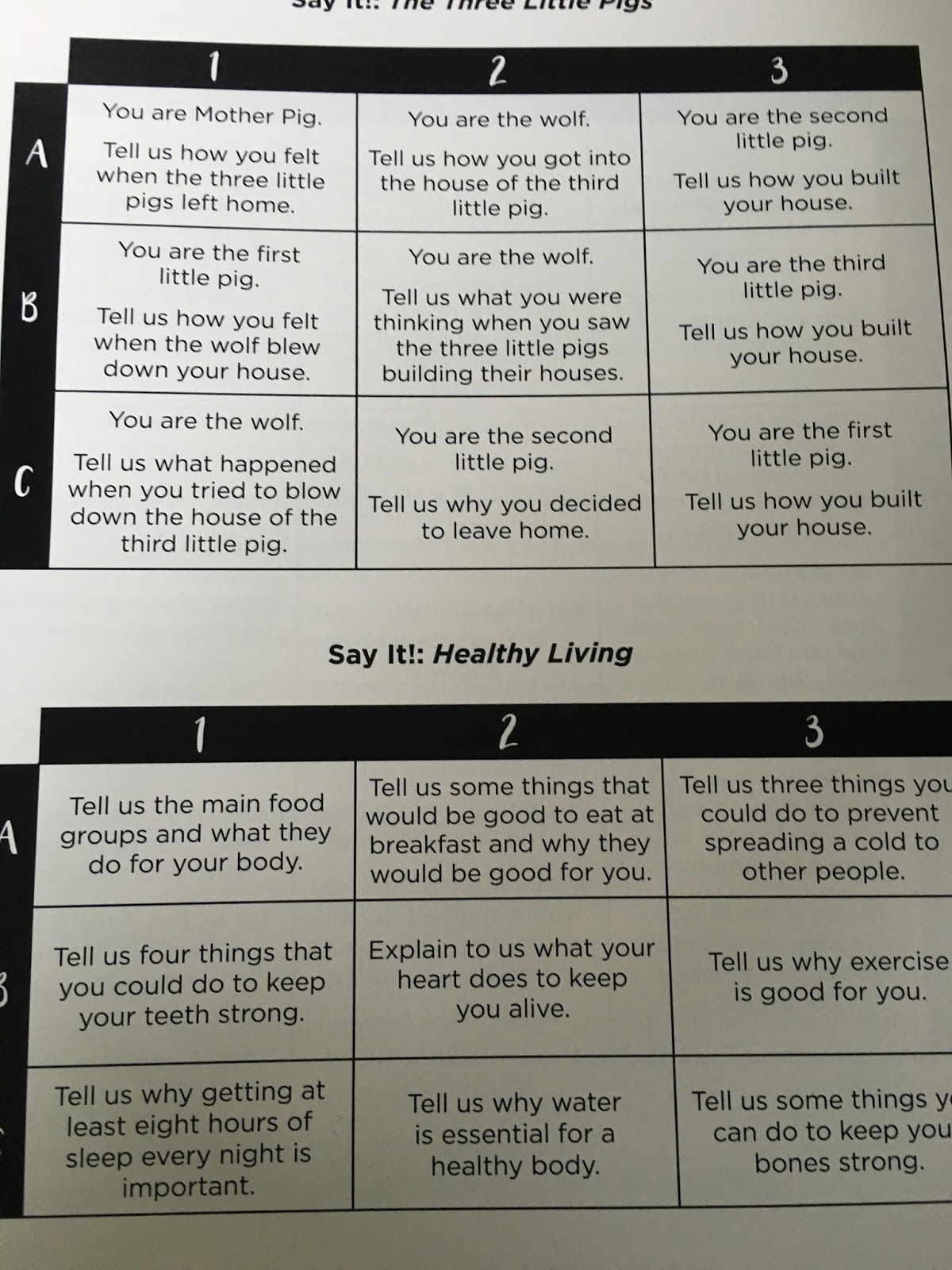
  • Say It! - create a grid of 9/12 squares, and write a simple structured role play based on the topic/book. Sts throw dice to work out co-ordinates and the st carries out the short role play.

  • 3 Level Guides
  • What Am I Thinking? - Character from the book with a speech bubble. Sts write down what they think the character is saying or thinking at a particular time
  • Tell the Story - sts have objects/pictures from the text and order and retell
  • Sequencing - sequence the text

Oral Language and Writing Activities

  • Dictogloss - sts jot down notes whilst text is being read and then in pairs/groups reconstruct the text, You might choose to provide a writing frame (first few letters of each sentence)
  • Running Dictation - place parts of text around room, the runner needs to read text and then run back to tell the group
  • Listening grids:


  • Skills Flow -sts have a series of photos, they label each picture as you read out sentences from a text (sentence 1 = picture 1), sts then retell the story using the pictures, sts then write sentences under the pictures


  • text reconstruction 

Digital Oral Language Activities

  • Bus Stop - place devices around the room set up to play short videos, sts jot down the main idea about each
  • Template - give each st a template to write on as they watch a video


skdkDljslklsakdjlksdl