Wednesday, 25 April 2018

Community of Schools’ (CoSs) leadership

Community of Schools’ (CoSs) leadership 

Throwing money and hoping for success? By Linda Bendikson


Improve learning outcomes by having successful teachers and Principals share their knowledge across schools. 

Leaders need to engender trust and confidence.

On the job competence - identify problems and find solutions
Start with smaller problems to build up accomplishment. the people who did the work need to take on the goal as their personal goal.

School -
What is impeding learning?
Need data literacy to discover the answer.

Why does the process fail in schools sometimes?

  • Leader is not tunnel-visioned (trying to take on to many goals)
  • Leaders do not measure immediate outcomes and provide feedback
  • Leaders do not sustain their involvement (they slowly drift away)
Skill of a good Cross COL Leader
confidence in ones own knowledge of the process
courage to take a strong lead
ability to inspire others to act in a timely way


HOLDING OTHERS ACCOUNTABLE
We are all in this together!!


Leading in collaborative, complex education systems 

Commissioned paper for New Zealand Education Council - Matatū Aotearoa Jane Gilbert AUT University August 2015

System wide change has to come from within the system. not from the top down. For the modern world a new approach is needed, not just a change in vocabulary. 

Complex Thinking
Previously educational thinking was 'scientific thinking'. Each part was the part of a machine and interconnected and linear. There was stability, predictability and certainty. Systems were a closed circuit.
On the other hand complex thinking is about the system. These systems adapt quickly to changing conditions (like a flock of birds flying).  Small changes to the system can have big effects and big changes can have little effects. 

Leading in Complexity
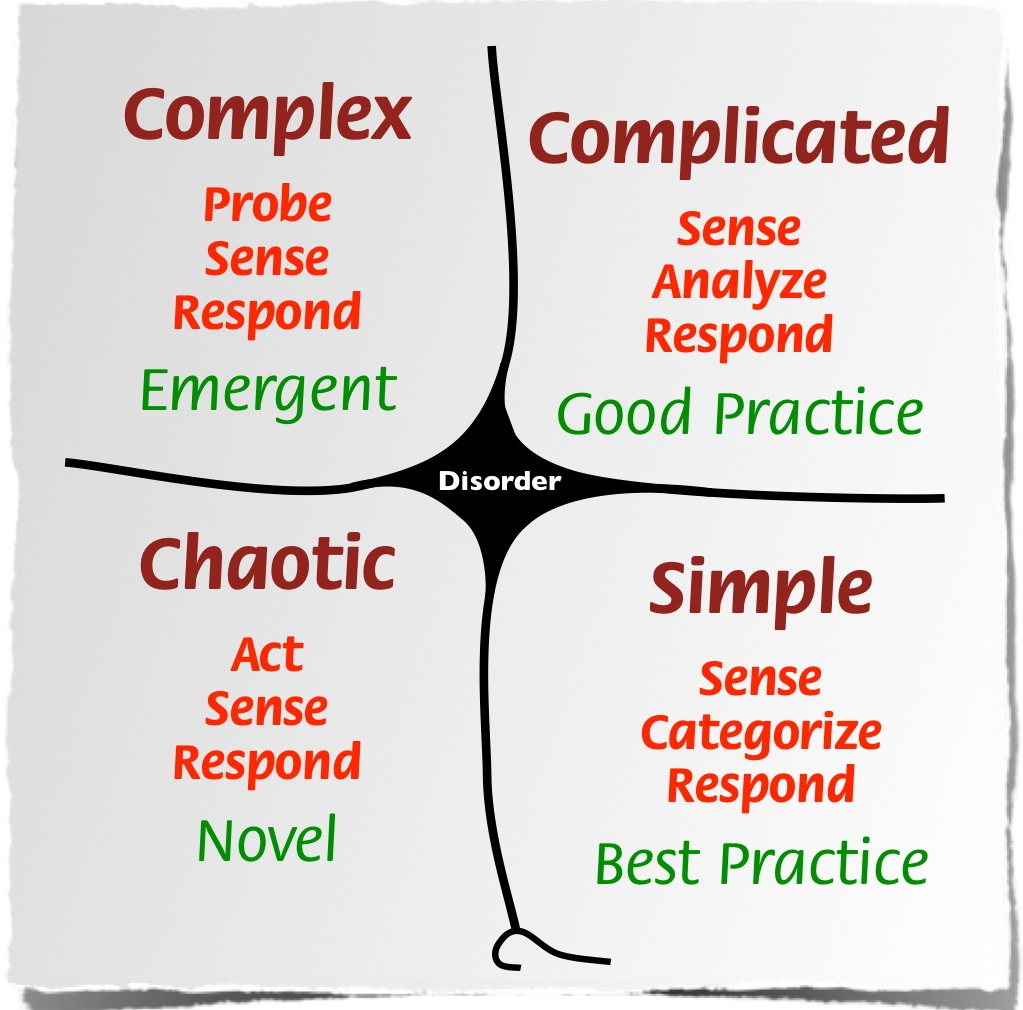
(Snowden & Boone 2007)  Before making a plan in any given situation  you need to decide whether the situation is simple, complicated, complex or chaotic;

  • simple - follows a pattern/sequence; occurs regularly and can be responded to by formulas.
  • complicated - also reliable and predictive, but no one knows why - data must be collected and analysed. Once experts are agree a  formula can be developed and followed
  • complex - the realm of the unknown. Nothing is predictable or reliable. Complex systems cant be controlled but can be steered towards a vision. The most useful thing is the noticing of the emergence of new patterns. 'One-size fits all solutions most likely won't work


Image result for Snowden’s Cynefin Framework 1
Snowden’s Cynefin Framework


Leading in a Complex Education System:
Important things; collaboration, secure trusting reationships
BUT the most important is a commitment to moving forward together
leaders should not have any ideas as to an ideal solution, all ideas are to be put forward

Think-piece on leadership education in New Zealand 

By Dr. Jan Robertson


Effective Educational Leaders;
  • self-aware
  • think deep about their practice
  • system leaders (care about students at the school down the road as much as those at their own school
  • are partners in realationships
  • emotionally, socially culturally and cognitively intelligent and responsive - see importance in developing those around them
  • creative, informed thinkers
  • confident and intentional
  • digitally competent
  • comfortable with being outside their comfort zone

Coaching leadership and potential in others is a facilitative  practice which is based on collaboration, the sharing of ideas, focused on the creation of knowledge. Leaders need to know how to learn from their own practice with and from others


Networked Leadership

 By Derek Wenmoth

School leadership is recognised as a priority area in many countries. Since 2011 NZ has had the National Aspiring Principals Programme. Australia have chosen a more systematic approach with the opening of the Australian Institute for Teaching and School Leadership.

  • Challenges in NZ schools:
  • competition between schools
  • hierarchical approach to school leadership
  • lack of accountability in current leadership  development programmes
  • lack of leadership development pathways
  • lack of rigor around entry to leadership programmes


A educational community is an ecology rather than a structure that can be owned or managed. 
The onus must be on the leader. No amount of coercion will make a community operate, no matter the structural planning and thinking.

Key Principals that will increase the likelihood of success;

a set of well researched professional standards for leaders
theory and practice are linked to professional standards
design programmes of support and engagment
build support around coaches and mentors
allow the community to grown through through fluidity 
provide tools to measure the programmes effectiveness
provide a range of blended learning programmes
robust, modern learning environment within which interactions and discourse can happen


Leaders need to;


  1. change thinking
  2. change behaviour
  3. change system

EDUCATIONAL LEADERSHIP FOR TOMORROW 

Mason Durie 


Leadership should be - inclusive, strategic and collabrative

INCLUSIVE - leaders are aware of the inter-relationship they have with others, others success leads to their success

STRATEGIC - a knowledge of what needs to change and the ability to manage change

COLLABORATION - knowledge of the power of collaboration

Leaders for Learners - are enthused with the vision of learning for a community and everyone is involved, their first priority is learners of the community (not of a particular school), recognise the value of whanau, form alliances between schools, aware of community needs so appropriate opportunities are offered.

 "Strategic leaders want learners to be ready for change and to acquire new ways of gaining and processing knowledge".


Wednesday, 7 March 2018

Making Space For Learning

Making Space For Learning

Trauma Informed Practice in Schools

  by the Australian Childhood Foundation


Understanding Trauma in Children

Traumatised children frequently do not have their feeling acknowledged. They do not trust their feelings. The strength of their fear, shame and sadness can overwhelm them. They often experience problems with learning new things, coping with new people and situations. the memories of the abuse are pronounced and ever present. Small reminders may cause them to relive their fear and confusion. 

What is Trauma?

Simple trauma - Overwhelming and painful, life-threatening and or/have potential to cause serious injury. Often a single incident, shorter in duration. Egs, earthquakes, car accidents, house fires, bushfires and cyclones
Complex trauma - involves inter-personal threat, violence and violation. Includes multiple incidences and therefore a longer duration. Almost always associated with stigma and a sense of shame by the victim. Egs, child abuse, bullying, domestic violence, rape, war and imprisonment.
Developmental Trauma - Trauma that has effected the child's brain development, often leading to splintered development.  The trauma undermines the very resources that could help the child recover - the stability and predictability of their connections with others.

How Complex Trauma Effects the Developing Brain?

Complex developmental trauma reduces the capacity of the thinking part of children's brains to shape the way they react to challenges in their environment. As a result they appear to behave instinctively and sometimes inappropriately, without knowing why. They are also not able to easily influence their feelings when faced with perceived threat or increases in their experience of stress.
It impairs the bridge between the left and right hemisphere. As a result, the children find it difficult to name their feelings, read social cues and respond in social exchanges. 
It heightens their arousal base to the extent that they can live in a constant state of vigilance and heightened alarm. They can be easily triggered by seemingly minor issues.
It locks down their capacity to adapt to change in their environment. They will use fixed and repetitive behavioural routines in situations where they feel uneasy, as this is comforting - even if the routines are destructive or harmful to others.
They will lack the ability to adapt to changes in situations and contexts.
They will react rather than respond.
They are unable to take in much information as their brains are in overdrive.
Their memory systems are under stress so they will fail to consolidate new information.
Their future is without plans or a sense of possibilty.

Trauma And The Body

For traumatised children the best option is to always be alert to danger and consider any change a threat
The body makes itself as efficient as possible by inhibiting any non-survival-related process such as digestion.
It focuses on conserving energy and resources for survival. There is no room for new information to be considered.
The brain and body respond in thinking, feeling and behavioural patterns which are ingrained.
Exposure to chronic stress desensitises the threat detection area of the brain and sometimes a threat can be perceived when there is none.
The individual becomes stuck in this cycle of trying to keep everything as familiar as possible. They rely on parents and caring adults to help support them by removing the threat or reducing its impact.
Children may not progress much further than the milestones they had reached when the trauma began.
The best way to support these children is to adapt the environment to the child's needs. The environment needs to be safe, predictable and nuturing.
Those working with these children need to be understanding and compassionate and offer orientation for hope and growth.

Trauma and Memory

When routines change the children are disrupted. Interaction with carers that repair disrupted routines engender trust in relationships.
However, children who are provided with chronically inconsistent responses are unable to form the memory templates they subsequently need to feel settled.
As children mature they are able to store language and concepts. Memory structures increasingly develop the capacity to store sensory dimensions separately to to the details (the who, when, where) Recall can bring about memories without sensations. Sensations can be described separately and with the events which precipitated them. They are able to reflect on memories in clam states. They can suspend painful memories in time so as to not be overwhelmed by the intensity of sensory experiences from their past when it is counterproductive to them.
However, memories are different for a child who has been through trauma. When they are exposed or confronted by cues associated with the trauma their memories flood back with the full force of sensory memory fragments. The child is, in the moment, unable to understand that the response they are having relates to the threat of harm posed by the raised voice of an abusive parent in the past, and not by the non-threatening raised voice in the classroom at present.
As a result they shut down their memories and do not engage with them, As such they do not rehearse building memories about themselves overtime andn will struggle to recall their success stories about themselves and relationships. Their memories do not form the stories they need to understand who they are, what they are good at and what relationships with others means to them,
Traumatised children need relationships that provide the memory resources that they lack or actively do not use. They need opportunities to keep their memory systems active through practice and rehearsal in conditions in which some of their internal stress and arousal has been reduced. In calmer states, children have access to greater cortical resources. They begin to have greater access to their working memory. They are able to consolidate learning. Traumatised children need to relief of a safe place to lay down new and helpful memories, which in time can begin to supersede the pain of their past.


Trauma and Emotions

Children who have experiences trauma have limited emotional literacy. They do not understand their feelings and are unable to explain them for others to understand. Negative and critical feelings, suh as confusion, shame, guilt, disgust and worry can trigger off memory traces of the trauma. 
Traumatised children cannot easily access their cortex to calm themselves down or regulate the strength of their feelings. Adults in their lives need to calm and comfort them to sooth the cortex. Children become aware of their internal state by seeing how others react to their feelings, this is how they develop emotional literacy. Children compose a framework for their feelings from the predictability of the responses they receive from others to their behaviour and emotional state. Predictability is the key through which children manage to negotiate how they have their needs met in their social exchanges. Consistent, congruent and validating responses give them the effective blueprint for organising their internal world.
Instead of validating and acknowledging a child's feeling and abusive parent or carer may escalate the child's confusion or fear by responding aggressively or blaming the child for their behaviour. In unpredictable relationships, parents and carers may sometimes respond safely and supportively, then without warning, they might react angrily, aggressively or negatively. In this situation, there is no predictability, so the child's life remains disorganised. The child does not trust the external world to offer stability.
Another emotion experienced by traumatised children is the feeling of disconnect, It serves the purpose of allowing them to disconnect so they do not feel so strongly the abuse.
When they are triggered, their emotional states are re-experienced with the similar intensity with which they were stored.Tracking a child's emotional states over time is a way of staying i touch with how, why and when different feeling become experienced and expressed.
Emotions assist children to belong to a social group who share their feelings. Traumatised children often feel different to others. If trauma or stress occurs during periods of time when the right hemisphere is more dominant in its maturation, then children will experience difficulties in being
able to read and interpret social cues of others. They look for others whose history and background makes its easier for them to be with. In this group they do not have to tolerate others feelings because there is only a limited range of feelings ever expressed. Without intervention aimed at supporting better connection and social skills, traumatised children are likely to experience increasing levels of isolation.
Traumatised emotional states affect children without warning and invisibly.

Trauma and Relationships

The more predictable the response to them the greater the confidence that children develop in both what they feel and how they understand the world. In particular, they learn that they are able to solve problems.
Supporting children to re-experience relationships differently is the key to trauma recovery and change. These compensatory relational experiences centre around the following key features:

  • there is a consistent approach to communication
  • children have their feelings validated and acknowledged by adults
  • children experience adults being protective of them 
  • children experience adults trying to take care of them even when their behaviour is challenging and complex.
With these examples the children can have hope that not all adults are the same. Over time, as the experiences are repeated, they become working templates for the children to apply in social exchanges and relationships.

Trauma and Behaviour

Comfort seeking - Children will seek out comfort from people whom they see as safe, consistent and nurturing. This includes seeking out physical attention from others, sitting close and engaging in parallel play, wanting to be fed and wanting their hands or heads to be stroked. They might engage in self soothing routines.
Self protection - Children will try to avoid intimacy at all costs. They do this for their own protection.

The key to reshaping trauma-based behaviour is to understand it and respond to its source rather than how it is expressed. Small examples of teasing can be experienced as large shifts in allegiance, rejection or humiliation. The relationship component of behaviour needs to be kept in constant focus when trying to understand the needs of children effected by trauma.
Trauma-based behaviour has served a survival function for the child. It may continue to serve its purpose in the child's current context. As such, this behaviour is most likely to stop when its function is no longer needed. These children will not necessarily respond to incentive-based reward systems. 
Strategies for addressing trauma-based behaviour will be most successful when they are applied purposefully across multiple settings in which children live, play and learn. With reduced memory capacity traumatised children and young people will find it difficult to generalise their learning from specific situations to related and unrelated contexts. No single approach will work al the time. Always consider the internal stress levels experienced by the child. Effective strategies will offer comfort and calm as the basis for change, aleviating additional stress on an already stressed body-brain system.

Trauma and Learning

The ability of traumatised children to learn is greatly compromised. Their neurobiology is stressed, their realtionships feel unstable, their emotional state is in flux, they find it difficult to stay calm or regain a state of calm if they feel distressed or perturbed. Change is perceived as dangerous, their memory is under pressure, they are disconnected form themselves and time, their behaviours rule them and new experiences and new information carry with them elements of threats and uncertainty.
Depending on when the trauma happened during brain development children may experience difficulties with being able to process language, difficulties with executing logic and sequences tasks (this will mean maths and problem solving tasks will be extremely difficult), they will find narrative-based techniques complex and at times indecipherable. As sport they will struggle to play.
Also the constant interaction with others will cause a lot of stress.

Using SPACE


Staged
Predictable
Adaptive
Connected
Enabled


Trauma informed practice has as its main ambition to support children to reset their baseline internal stress and arousal levels in order to bring their cortext back in line.

Staged - Strategies aimed at resourcing traumatised children need to follow a staged pattern of conceptualisation and implementation for them to succeed.

Predicatabilty - The people and the environment in their lives needs to be predictable. With stress reduced the children will have the chance to experience themselves as more flexible and be more able to tolerate small degrees of change.

Adaptive - In school contexts, traumatised children struggle to internalise collective rules and understand the consequences for breaking them. Strategies which promote adaptability in children are those which are able to maintain multiple meaning for behaviour and remain open to multiple options for intervention.

Connected - Traumatised children develop insecure and unstable templates for forming and maintaining relationships. Effective strategies to support traumatised children emphasis relationships with safe and consistent adults and peers as the foundation for change. Relationships become the primary vehicle through which new meanings about feelings, beliefs, behaviour and idenity are resourced to emerge.

Enabled - Traumatised children find the process of understanding themselves difficult. They are challenged in their capacity to identify their feelings and understand them and communicate them to others. Effective strategies for responding to traumatised children in the school context will enable them to make linkages between and give meaning to their experiences of their past and their present, the feelings and their behaviour, their thoughts and their actions.

Putting Space Into Practice

Suggestions - 

  • create spaces for the students to move into and still be part of the class group. Tactile corners in the classroom that have beanbags or a rocking chair, stress balls or a plush rug.
  • create structures in which children can make choices during their day.
  • written plans for children that are made accessible to relevant school staff.
  • keep a journal of the child's emotions over the course of a week. Look back to see what factors are influencing a child's behaviour
  • capture and record the experiences of a student at school every week. Join the child in reflecting on these experiences in a sequenced way that enables the student to rehearse building a narrative about their involvement at school. Recognise and acknowledge the student's involvement in school activities.
  • provide impromptu fun experiences which are not defined as rewards. Fun and playfulness act as resources in the lives of stressed children.
  • use a digital camera in class to 'catch' the students doing the right thing and help them reflect on their strengths and commitments.
  • Include stretching and physically relaxing activities at predictable times each day
  • create a calm box; photos of favourite things, sensory rich objects
  • build rhythmical rehearsal opportunities that support arousal regulation.  For example, use the excitement - calming - concentration phases in regular classroom activities throughout the day
  • set up a shadow board outlining what the students will need to each class/lesson/subject
  • integrate emotional literacy activities into the curriculum to support students to recognise, name, manage feelings and learn to respond to others' expression of feelings
  • rehearse narrative structure by drawing the day's journey using different media including chalk, text, wool, clay
  • create videos/dvds which provide a history of the year/class/week/camp experience and enable review of this work
  • utilise music in the classroom -  particularly rhythmical drumming

Final Words:

Hope is the outcome of change for children. For these children, hope comes from feeling that their experiences of trauma and stress no longer separates them from their friends and family/ They know that they do not have to feel alone any more. They can feel safe, secure and loved. School itself becomes easier to navigate. They have greater attentive capacity. They have access to more of their memory resources. They can take in more information and store it. They can recall it and integrate it. They develop new skills. They learn and come to enjoy learning.


Saturday, 24 February 2018

Well Being & Mental Health

Hereora Cluster Teacher Only Day
25/01/18
Lucy Hone


Well-Being & Mental Health:

Well-being definition - 'feeling good and functioning well'


Increased well-being;
  • Increased ability to cope with stress
  • Lower incidence of cancer
  • Faster recovery from surgery
  • Greater immunity to colds and flues
  • More resistance to trauma
  • Greater job satisfaction
  • Increased productivity
  • Higher levels of optimism
  • Greater levels of self-control
More engaged students

What determines our happiness?
Genes 50%, Actions and Thoughts 40%, External Circumstances 10%

Positive Education:

The bringing together the science of well being with best practice teaching to support individuals, schools & whanau to flourish.

Pastoral Care; reactionary, targeted, deficit-based
Positive Education; preventative, universal (whole school community), strengths based

Adler and Seligman, 2016 - Teaching Well-Being increases Academic Performance - perseverance, engagement and personal relationships


Goal Setting
Set a goal and make a plan

Positive Emotions - engagement, relationships, meaning and purpose, achievements
Check in as an individual, class, school

How can we promote well-being in school communities?

Always start with the staff (and include ALL staff)

LEARN IT ⇒ LIVE IT ⇒ TEACH IT ⇒ EMBED IT

Schools represent the only way to achieve universal well-being promotion


24 Character Strengths

To identify your personal strengths take this scientific questionnaire


Greater awareness and use of character strengths is associated with:
Improved school performance (Quinlan, 2014)
⇝ engaged learning, increased happiness
⇝ enhanced class climate
Greater odds of having higher well-being (Hone, 2015)

Martin Seligman:


Our strengths can change, we can work on them (not traits)
Character = a set of strengths that contribute to well-being (universally valued, across cultures)
Character = associated with positive outcomes regardless of socio-demographics.
When you know and act on your character strengths, they give you PERMA.
The VIA provides a framework & collective language to discuss

How can we improve PERMA in our classes?
Regular measuring so you are aware of it and work out ways to improve it.

Strengths - activity ⇒ character (what are the things we need to be good at to do the activities

Strengths are ....  things we do well, often and with energy

Resources:


SCHOOL BASED MENTAL HEATH TEAM


Providing resources to help the school to provide for the students. resources, workshops

Issues to Resources (where to find support in different areas)
Have done social skills groups with students
Have run transition programmes
Sparklers  (allright.org.nz) - has parent and teacher guides
Whanau Effect - promotes connections with whanau
Hikitia te ha (Maori Tai Chi)

Learned Optimism

Sharon Bennett

We need to practise being optimistic
Learned helplessness

To think is to know
To think is to learn

informing vs transforming

Can I control it ?

Yes - then sort it out
No - Let it be

Only 10% of happiness is based on external influences, 90% from inside

Our society focus on fixing the negative

Appreciative Inquiry - Asset based
a pholosphy
a way of looking at the work
a strength based framework
methodology
appraoch


Wednesday, 27 September 2017

Calmer Classrooms

Calmer Classrooms - A Guide to Working with Traumatised  Children

A document by the Victorian: Department of Communities, Child Safety and Disabilities Services

Attachment and early security: building resilience

Help the child to know their own feeling states by giving words to their experiences (oh, you look tired, what a beautiful smile - you look so happy, you're really upset now).
Help the child to regulate their body and to know physical boundaries by holding them , touching, playing with them and comforting them.
Without these early experiences we grow up not recognising or understanding our emotional and physical states and consequently not making good decisions and judgments, not able to manage strong emotions and lacking trust in the world.
If we don't get attuned and loving early care ourselves, we tend to act on our emotions, not being able to think or put the other's needs first.
Over time, as the process of exposure to stress followed by protection and comfort is repeated, the child develops an ability to rely on an internal sense of security, and resilience is built.


Attachment, trauma and the impact on development

Trauma occurs when an event is so frightening it cause a prolonged alarm reaction, where the body is primed and pumped with chemicals and enzymes such as adrenaline and does not calm down to a long time.
80% of human trauma occurs within the family setting/
Children who have suffered chronic abuse or neglect often experience developmental delays across a broad spectrum, including cognitive, language, motor and socialisation skills. Trauma affects the whole person; their mind, brain, body spirit and relationships with others.
Children with 'Development Trauma Disorder (van der Kolk) 'manifest in multiple ways their tendency to re-enact and replicate the trauma throughout their lives.
Because these children are prone to experience everything as novel, including rules and other protective interventions, as punishments, they tend to regard therapists and teachers, who try to establish safety as perpetrators.


Impact on the Brain and Body

When someone is traumatised by extreme or repeated events of abuse, chemical reactions in the body and brain can be switched on as if they have never been switched off.

'Each time a (traumatised person) has a flash back or nightmare, or is merely startled by a sudden sound or movement, his heart, lungs, muscles blood vessels, and immune system are primed to save their life - from nothing at all.' (Beaulieu 2003)

Their reduced capacity to regulate strong emotions leads them straight to reaction, with no time to think. There are two reactions associated with affect dysregulation;

Hyperarousal - children are hyperactive, hyper-vigilant, alarmed, prone to aggression or flight.
Dissociation - disengaged, numb, compliant and inattentive.

'Many traumatised children and adults who were traumatised as children, have noted that when they are under stress they can make themselves 'disappear'. That is, they can watch what is going on from a distance while having the sense that what is occurring is not really happening to them, but to someone else.' van der Kolk, 1996

Trauma effects thinking. Children who have experienced trauma often seem disorganised. This is sometimes due to the fact that some victim's cope by refusing to conceive of their caregivers thoughts, thus avoiding having to think about their caregivers wish to  harm them. They close down any thoughts that come into their minds. Eventually they will hardly think about anything.
This makes social situations difficult as we need to be able to things about what other people might be thinking.

Self-harm is common in children who have been traumatised, sometimes due to the endorphin release and sometimes out of a profound self-hatred. Others self harm to overcome the numb and alienated feelings that come from dissociation. Some may even internalise the aggression of the abuser and then become the victims  of their own aggression.

Intervention and Recovery


Research shows that the earlier the intervention is applied, the more efficient it is. Recovery cannot happen if the child is not feeling safe. Also, for us to be happy we need to know that there is someone who cares about us. That is the basis of security.

Recovery can take place only within the context of relationships; it cannot occur in isolation. (Herman 1992/1997)

The impact of abuse and neglect on learning


Academic Performance

Some children with severe early neglect and/or severe traumatic experiences have cognitive delays.
Students who are highly aroused have attention difficulties, which then lead to academic and cognitive problems as the child finds it difficult to concentrate on learning. 

Some students will have trouble sleeping at night this could be due to fear of what might happen in the night or that they have never been taught to settle themselves. Others will develop internal patterns of hyperarousal, anxiety and fear which interfere with their sleeping patterns. This means that the child will be unable to concentrate in class.

Some traumatised children may be overwhelmed by memories of abuse, which preoccupy them and reduce their capacity to concentrate.

Trauma and attachment disruption reduce the capacity to listen and retain information, to understand complex concepts and to express ideas and thoughts. Early relationships should be rich in language, including the language of emotions and relationships.


Social Functioning


Traumatised children might try to control their environment and the adults within it due to the fact that they had no control over what happened to them earlier in life.

These children may have not had secure attachments at home and may struggle to attach at school and may need help to do this. Some children might like the security of school if their home life is unpredictable. If students have moved schools several times they might perceived themselves as being 'alien' to the school environment, different to and deviant from peers.

If students are moving school as well as home, this is a double whammy.

Affect dysregulation: seen as hyperarousal or dissociation

Hyperarousal usually goes hand in hand with hypervigilance. The child is constantly on alert and unable to listen or focus.

Disssociative children often do  not know how they feel; seem distance, vague and unreachable and they may become oppositional as s response to a demand for attention, contact or closeness. They often do not want to think.

Children who have been abused and neglected have intense shame responses. It is as though all the humiliation of the abuse is triggered at any time they perceive themselves as failing or wrong; leaving them feeling very bad about themselves.


People who live with toxic shame feel fundamentally disgraced, intrinsically worthless, and  profoundly humiliated in their own skin, just for being themselves ... toxic shame arises when as individual's inner core is tormented through rejection.' (Garbarino, 1999).


Calmer Classrooms

Relationship-based Practices


Creating Connection and Defusing Conflict

  • The most effective a strategy a teacher can have is a good understanding of the child's background and the reasons behind their behaviour and empathy for them.


  • Keep the child close beside you; giving losts of support and supervision (as for a small child). You may need to walk beside them to help them calm down.
  • avoid showing emotion when the child makes you angry or upset (don't let them control your emotions).
  • instead of giving warnings, help the child comply. Warnings and second-chances do not work so well with these children as they don't form attachments and probably see no value in pleasing adults and establishing relationships.
  • When a problem arises, address it directly and calmly; giving the child clear direction and an outcome that is controlled by you.
  • Time out might replicate the rejection that the child has experienced and reinforces the child's internal view of being unlovable. Reframe their disruptionn as a need for your attention and help.
  • Consequences should be natural consequences and be designed to repair damage and relationships
                         'Seeing that you spent a lot of time swearing this morning. I want you
                          to come to the library with me and we will look up some other words
                          you can say when you're angry.'

  • If they are seeking your attention - give it to them. It won't be too long before they are so disillusioned with the adult world that they no longer seek your attention, and then they will be so much harder to connect with and to help.
  • These students might try to control situations and to engaged their teachers in power battles. Offering choices, any of which get the job done, is useful.
  • You, as the teacher, are in charge of the relationship; keep anger and frustration out of your voice
  • When helping a child to self-regulate use a soothing voice to remind the child that you are helping them by removing them to a quieter place.

  • After an incident, help the child to understand what happened. Ask the child to reflect on what was happening for them before and during the event. Children will often say 'I don't know,' in this instance you can respond by saying 'It must be hard and confusing not to know how you are feeling then difficult things happen. Then provide the child of a narrative of the narrative you have gathered. Check the child has heard and understood; listen to their story and agree to change the narrative if there is a mistake that does not contradict your observation or you know to be true. Make sure the child has heard a comprehensive narrative about the event.


Self-care for Teachers


Reflection
Regulation
Relaxation

Reflection:
  • Reflect on the child's behaviour ... What are they doing, and why might they have been doing it?  
  • What are they trying to tell you through their behaviour?
  • What are my thoughts and feelings, can I regulate myself?
  • What are my responses in relation to the child's behaviour?
  • Where is our relationship at? Is the child able to connect with me and listen, to take strength  from the support I am offering?
  • What assistance do I need to do this work?
  • What can I talk to about how I feel?


Sunday, 6 August 2017

Oracy In the Classroom   30/07/2017

Text

Create discussion guidelines:

  • Always respect each other's ideas.
  • Be prepared to change your mind.
  • Come to a shared agreement.
  • Clarify, challenge, summarize, and build on each other's ideas.
  • Invite someone to contribute by asking a question.
  • Show proof of listening.  (important as this shows respect)
We need to teach children the different roles in a conversation:
  • instigator - starts the conversation
  • builder - builds on and develops further other people's ideas
  • challenger - provides an argument
  • clarifier - makes things clear (like a commentator)
  • prober - asks questions to go deeper
  • summarises
Activities that encourage speech

  • talking points: students need to say 'I agree or I disagree because ...
  • ghost reading: students takes turns to read but decide how long they read for
  • collective writing: after writing on a topic students collectively talk about it, each choosing how much they say
English
  • A similarity between these texts is…
  • A difference between these texts is…
  • The author's choice of X shows…
History
  • In this era…
  • This artifact shows that…
  • This source illustrates that…
  • This source is biased because…
  • This source is more reliable because…
Art
  • I like this picture because…
  • I prefer the work of X because…
  • The composition of this piece shows that…
  • The techniques I have noticed are…
Science
  • The results show that…
  • The conclusion I have drawn is…
  • There is a correlation between ... and ....
  • An anomaly I noticed is…
  • I have observed...


Notes from Behavioural Course

Individuals are more likely to grow, develop and make progress when they are in a postive environment that provides safety, support, structures and consistency.

The consequence can re-start the circle again if it is negative and done before student has desculated.


When a child says leave me alone …. leave them alone.
When you are upset and say to someone to leave them alone, you expect them to do this … the situation is the same for the child.

Positive responses

  • Ignore inconsequential behaviours (annoying and repetative)
  • Walk away and then re-engage - sometimes it is beeter to yet a staff member intervene. At other times, a brief cooling off period is more advantageous than an immediate response.
  • Share feelings - but don’t show - acknowledge that you the individual need to cool down before discussing the situation
  • Script a response - identify your ‘buttons’ and script a response to each
  • Remain focused on the individual’s behaviour - keep conversation on the behaviour and not the student
  • Self-talk - use an internal conversation to guide you eg ‘don’t take it personally,’ is the situation as bad as it appears,’ ‘ what is the individual wanting?’ and ‘what should I do.

AND
Stop - mentally interrupt any internal conversation before responding
Think - consider options and responses that have been pre-scripted
Analyise - decide on which strategy to utilise in this situation
Respond - choose the strategy and act

Response to Oppositional and Defiant Behaviour

  • Making deals - Do not bargin
  • Needing to have the last word (a strategy to have control where the individual tries to stop the conversation from ending) - Let them have it
  • Blatant rule violation (an attempt to get you into an argument and/or seek attention)  - temporarily ignore the behaviour and then give consequences later
  • Constantly questioning ‘Why” (an attempt to control and prolong the conversation and sometimes challenge authority) - agree to answer but in their time not yours
  • Playing one staff member against another (pointing out inconsisitencies and using it to rationalise their behaviour) - follow the schedule and communicate with colleagues
  • Refusal to comply (trying to take control by challenging you; a very difficult behaviour to understand as the indivdual’s pointn of view is correct (they cannot be made to comply) - review their choices (3 choices are good as they really have to think)
  • Loopholes (complying with the letter of the law but not its spirit) - provide specific instructions


The kids who need to most love will always ask for it in the most unloving way -  Russel Barkely

Paul Nation's 4-strands

 Paul Nation talks about four strands that need to be balanced:

Meaning- focused input (listening or reading, focus on communication, comprehension of the input and just a few unfamiliar language items. E.g. listening to stories, guided reading etc.)

Language-focused learning (receptive or productive, focus on language features, conscious attempt to learn a language item. E.g. dictation, vocabulary learning, pronunciation drill, text analysis, guided speaking etc.)

Meaning-focused output (speaking or writing, focus on communication, production of comprehensible messages, opportunity to improve control or skill or language items. E.g. information gap activities, letter writing, role play. etc)

Fluency Development (receptive or productive, focus on communication, pressure to perform at a higher level than normal, no unfamiliar language items at all. E.g. speed reading, fast writing, repeated talks e.g. 321 activities etc.)  


I want to include these ideas when planning to make sure I cover them all. I definitely overlook fluency development and have never planned for this. 


I also found this interesting -

'... should include form focused instruction in the sound system, vocabulary, grammar and discourse areas. Form-focused learning can speed up learning, help learners to overcome barriers to language development and can have a positive effect on meaning-focused learning. It should take up about 25% of the learning time.  The language features focused on must be reasonably simple, be at an appropriate stage of development to benefit from the attention; and if the purpose of the learning is to make learning from meaning-focused input more effective, then it is sufficient to raise learners’ awareness of the item and its use. Language-focused practice does not usually lead directly to implicit knowledge of language that is needed for normal communication, it is more of a support for meaning-focused activities.'  


There is still a place for form learning, we just have to decide what is the focus, will learning form help to improve future learning or is it deviating from meaning.

This is from:

[Primary ESOL] ESOL Course Design - The first 10 principles: Primary ESOL Online Update, 3 July 2017 (emails)


To help with fluency I have chosen a sentence from each students writing that contains errors and I have rewritten it for them at the top of the page. Next session I will get them to write it as many times as they can in one minute, we will record the results and then repeat. This way they are fluently learning the correct grammar/vocab that they didn't know.